Wednesday, June 10, 2009

KALPA VRUKSHA, MIHINTALE

MARVELS OF ART & SCULPTURE - by D.C. Ranatunga, The Sunday Times, 7 June 2009

Marvels of art and sculpture

The centre of attraction for pilgrims on Poson Poya is Anuradhapura with Mihintale also on the itinerary. The many places of worship on this hallowed rock are works of art created by the talented craftsmen dating back to the 3rd century B C.

By D.C. Ranatunga.

Photos: Courtesy – Eloquence in Stone: The Lithic Saga of Sri Lanka Studio Times publication

Eight miles out of Anuradhapura, the rocky mountain of Mihintale rises abruptly out of the plain to a height of almost 1,000 feet. Here on the slopes of the mountain Apostle Mahinda encounters the king (Devanampiyatissa) as he was in pursuit of a stag. Standing on top of a great crag now known as the Aradhana Gala, the Rock of Invitation, the Apostle Mahinda told him the story of the Buddha and preached His doctrine. The conversion of the king and the whole country to Buddhism provides the foundation for our story. The kings of Lanka saw it as their duty to build for the glory of the faith ….

The Buddha's message unleashed the creative energies of the Sinhalese. Letters were engraved on stone, caves and then temples were hewn out of solid rock. Great dagabas were built in worship of the Buddha and His image was carved out of granite and marble. Huge monasteries arose many of them as large as towns, their buildings adorned with stone carvings of the most exquisite kind.

The reader is thus introduced to the dawn of a new civilization in Sri Lanka in the book 'Eloquence in Stone – the Lithic Saga of Sri Lanka'. Under the patronage of King Devanampiyatissa (250-210 B C), the royal capital Anuradhapura became the home of Theravada Buddhism. The king gave the lead in building stupas by erecting the Thuparama dagaba and a monastery for the monks. The location came to be known as Thuparamaya to indicate the presence of the dagaba and the 'aramaya'. According to the Mahavamsa, Thuparama had been built by the time the branch of the sacred Bo tree was brought to Sri Lanka. One of the eight saplings of the Bo-tree had been planted at the Thuparamaya.

Although the accent was on Anuradhapura, the objects of worship found in Mihintale bear testimony to the fact that there was lot of activity there too. The Kanthaka Chaitya, for example, is a fine piece of architecture and a symbol of the rich art of sculpture in ancient Sri Lanka. The four 'vahalkada' (frontispiece) are unique and are amongst the oldest sculptures in the country.

As described in 'Eloquence in Stone', the Kanthaka Chaitya marks the beginning of stone art in Sri Lanka. "Elephants kneel out of the stone, dragons spout forth and grotesque dwarves, wild and happy, throw their arms into the air. Serried ranks of dwarves and women line the panels, playing instruments and dancing in ecstasy. The whole 'vahalkada' was once plastered and painted in different colours. You can still see the outlines of lions in red and orange paint, their hues coming to life with the sun. Only then do you realise that what is now grey and faded stone, was once a mass of living colour. "

The four 'vahalkada' face the four cardinal points in the dagaba. There are four beasts – elephant, horse, lion and bull – facing each direction. The true to life figures are carved in the round from dolomite marble.

Intricate art can be seen at the Kanthaka Chaitya. The 'kalpa vruksha' (Tree of Life) is portrayed as a flowering plant rising from a vase of scrolls. On either side of the stem animals and yakkhinis stand back to back perching on its leaves. Seated at the very top is Kuvera, the God of Wealth, showering prosperity on the worshippers.

Another popular site is the Kaludiya Pokuna used as a private bathing place by the monks of Mihintale. "Built to capture the rainwater as it cascaded off the mountainside, here man used his skill to harness nature and beautify it. The pond is surrounded by great rocky boulders which litter the landscape. The steps, terraces, gardens and pavilions which adorn it have all been built around the rock following its shape and contours.

Steps curve up the rock to pavilions set on top of boulders. Terraces make their way over the open ground ascending higher and higher to platforms looking out over the pool, its waters black with the reflection of rocks and the shade of trees. It is the perfect example of man in complete harmony with his environment. Another culture would have cut through the rock and removed the boulder. Only we let it be." (Eloquence in Stone)

The Sinha Pokuna was once an open air bath which served the monks living in the caves around the Kanthaka Chaitya. Here too intricate sculpture can be seen particularly the figure of the great, man-sized lion which gave the fountain its name.

Amidst the lush greenery in the sacred area of Mihintale are ruins of many monasteries and other facilities provided for the benefit of monks.

Labels: , , , , , , , ,

ELOQUENCE IN STONE - Review by Premila Canagaratna, The Sunday Island, 27 April 2008

Eloquence in Stone: the Lithic Saga of Sri Lanka

For many of us the history of a nation, even if it happens to be our own, can often seem dull and monotonous. But in the latest Studio Times publication, Eloquence in Stone: The Lithic Saga of Sri Lanka, this island-nation’s rich and varied history comes alive before one’s very eyes; the reader is catapulted head first into the tales of love and war, the intrigues and the conspiracies of those amazing and ancient times. Amazing, I say, because as one looks at page after page, one is struck anew by a sense of utter amazement at the feats of art, engineering and sculpture achieved by our forebears so long ago.

Tracing Sri Lanka’s history from the Stone Age (as far back as 125,000 years ago) to the Kandyan period, the last of Sri Lanka’s great kingdoms and the last stronghold of the Sinhalese Kings, Eloquence in Stone takes you, the reader, by the hand and leads you from one era seamlessly into the next. Each chapter in Sri Lanka’s history is described in beautifully-constructed, and rigorously researched, prose by Dr. SinhaRaja Tammita-Delgoda. His text admirably complements the visual artistry of Nihal Fernando and the Studio Times photographic team. The colour photographs undoubtedly add vibrancy, but the profusion of black-and-white prints, with their own stark beauty, gives added meaning to the very subject of the book.

Each chapter gives an overall view of the life and times of people in that particular era, followed by descriptions of specific sites, monuments and archeological remains which have been attributed to that period. The text is clearly footnoted and all the illustrations captioned, making this not only a work of art but also one of great academic value.

What makes this book stand out for me is that it is not simply a description of the art and sculpture of ancient Sri Lanka; it is much, much more, being also the fascinating story of the people and how they lived. In describing so lovingly the way of life in ancient Sri Lanka, the book cannot help but remind the reader of how radically those ways have changed over the years, and how far out of sync with nature we have become.

Describing Kaludiya Pokuna in Mihintale, for example, the author writes: “Built to capture rainwater as it cascaded off the mountainside, here man used his skill to harness nature and beautify it…The steps, terraces, gardens and pavilions which adorn it have all been built around the rock…It is a perfect example of man in complete harmony with his environment. Another culture would have cut through the rock and removed the boulder. Only we let it be.” Another culture? That unspeakable culture is very much with us already!

Another reason why Eloquence is so important and so timely is that it is a much needed record of the archeological richness and variety of this tiny island. Some of the sites and monuments featured here have now become victims to the passage of time and, worse still, fallen prey to mindless vandals and thieves; again, a sign of the times, you might say. Striking photographs of Kudirimalai Point in the Wilpattu National Park, taken more than twenty years ago by Nihal Fernando, show the remains of an ancient temple. Today, after years of neglect due to civil strife, the area is completely overgrown, with hardly a stone left uncovered to even point to its former glory.

Again, Andagala in Gal Oya National Park, once housed a monastery or perhaps a palace. The book gives us a glimpse of it in the form of many huge boulders of stone, a bathing pond and parts of a retaining wall. This site is not known to many in the area and it is not listed even in the Register of Archeological Monuments. Fortunately for future generations, however, Eloquence in Stone may be the only record of its existence.

Eloquence in Stone is, as I see it, truly a labour of love: love of the country, its people, its culture, its art and its famed natural beauty. It is this love that has spurred Nihal Fernando and his team at Studio Times to toil ceaselessly for a decade-and-a-half to place on record their pioneering work within the covers of this ravishing publication. It is also an historical document of immeasurable value to Sri Lanka and its people.

Nihal Fernando says at the end of the book: “This is the dream I have had for the last fifteen years. I want to tell the story of this country and its people. I want to make people think about our past and what we are doing to it before it is too late.”

It’s high time we Sri Lankans did just that, and Eloquence in Stone is the ideal aid to that long-overdue, and very necessary, cerebral exercise.

Premila Canagaratna

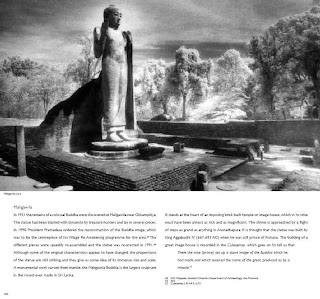
PAGES FROM ELOQUENCE IN STONE:
Maligawila

PAGES FROM ELOQUENCE IN STONE:
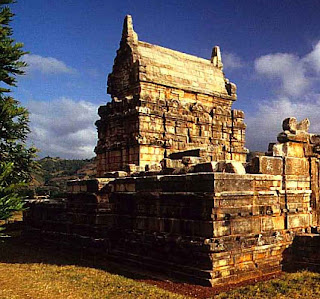
Nalanda Gedige
Labels: , , , , , , ,